 Search
 Eng
Eng 
 English
 Español
 Português

 Home / Newsroom / Industry News / What are the differences between OE quality brake pads and non-OE quality brake pads?
 What are the differences between OE quality brake pads and non-OE quality brake pads?
 2026.03.05
 Industry News
Content
- 1 The Core Difference: OE Quality Brake Pads Meet Factory Standards; Non-OE Pads Often Do Not
- 2 What "OE Quality" Actually Means for Brake Pads
- 3 Friction Material Composition: Where the Most Critical Differences Lie
- 4 Head-to-Head Comparison: OE Quality vs. Non-OE Brake Pads
- 5 Hardware, Geometry, and Dimensional Precision: The Overlooked Differences
- 6 Rotor Compatibility and Long-Term System Cost
- 7 Quality Certifications That Identify Genuine OE Quality Brake Pads
- 8 When Non-OE Pads Are and Are Not Acceptable
- 9 Frequently Asked Questions About OE Quality Brake Pads
- 9.1 Q1: Are OE quality brake pads the same as OEM brake pads?
- 9.2 Q2: How can I tell if a brake pad is genuinely OE quality when shopping online?
- 9.3 Q3: Will using non-OE brake pads void my vehicle warranty?
- 9.4 Q4: Do OE quality brake pads require a bedding-in procedure?
- 9.5 Q5: Can OE quality brake pads be mixed with non-OE pads on different axles?
- 9.6 Q6: Are there driving conditions where non-OE economy pads fail most noticeably?
The Core Difference: OE Quality Brake Pads Meet Factory Standards; Non-OE Pads Often Do Not
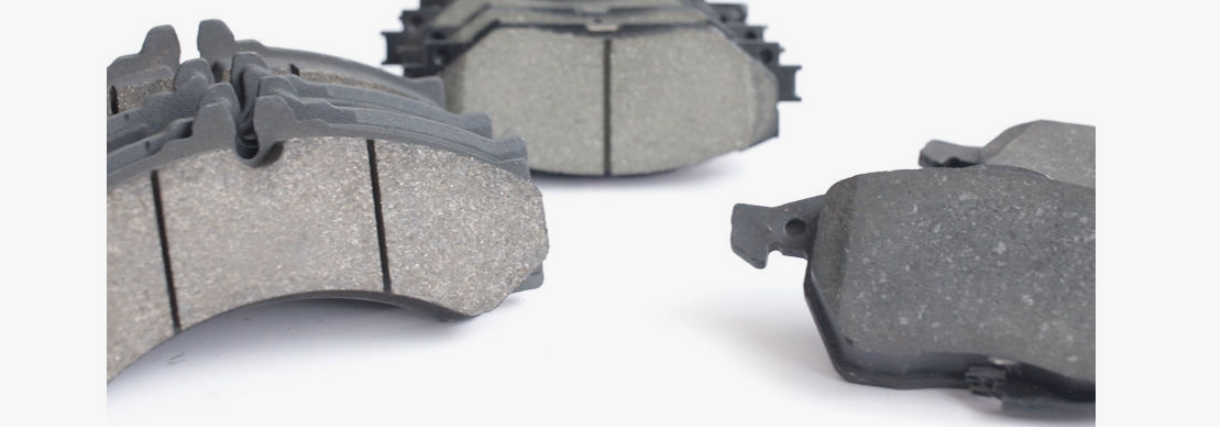
OE (Original Equipment) quality brake pads are engineered to match or exceed the exact friction, thermal, and dimensional specifications that a vehicle manufacturer validated during development. Non-OE pads—often marketed as "economy" or "value" replacements—are manufactured to a price point rather than a performance specification, resulting in measurable compromises in stopping distance, pad longevity, rotor wear, and noise behavior.
The practical consequences of this difference are significant. Independent testing has shown that low-quality non-OE brake pads can increase stopping distances by 10% to 25% compared to OE-equivalent pads under identical conditions—a difference that translates to 3 to 8 additional meters at 100 km/h emergency braking. For a safety-critical component, this gap is not a minor inconvenience; it is a measurable risk. The sections below explain precisely where and why these differences arise.
What "OE Quality" Actually Means for Brake Pads
The term "OE quality" is widely used but often misunderstood. It is not simply a marketing label—it refers to a defined level of engineering and manufacturing compliance:
- OEM (Original Equipment Manufacturer) pads: The exact pad supplied with the vehicle from the factory, manufactured by the brake supplier (e.g., Bosch, Brembo, Akebono, TRW) under contract to the automaker. These carry the vehicle brand's part number and are sold through dealerships.
- OE-equivalent pads: Aftermarket pads manufactured by the same supplier that makes OEM pads, sold under the supplier's own brand. For example, Bosch Blue or Brembo's aftermarket line. These use the same friction formulation and dimensional specifications as the OEM part.
- OE-quality certified pads: Third-party aftermarket pads that have been tested and certified to meet or exceed OEM friction coefficients, thermal limits, and dimensional tolerances—even if made by a different manufacturer. Certifications include ECE R90 (Europe), FMSI/SAE standards, and IATF 16949 quality system compliance.
Non-OE pads, by contrast, are manufactured without binding reference to the OEM specification. Their friction formulations are proprietary blends chosen for low cost, their dimensions may be approximate rather than precision-machined, and their quality control processes are often not certified to automotive industry standards.
Friction Material Composition: Where the Most Critical Differences Lie
The friction material is the heart of a brake pad. Its formulation determines how the pad performs across a wide range of temperatures, pressures, and surface conditions. OE quality brake pads use carefully balanced friction blends developed through extensive dynamometer and vehicle testing; non-OE economy pads frequently use simpler, less consistent formulations to reduce manufacturing cost.
Friction Coefficient Stability
OE quality pads maintain a stable friction coefficient (μ) across a temperature range of approximately 100°C to 400°C—the typical operating range for passenger vehicle brakes in normal to aggressive driving. Budget non-OE pads often show significant friction fade above 200°C, with μ dropping by 20% to 35% as the pad overheats. This is the physical basis of brake fade—the alarming feeling of the pedal going soft during heavy braking or repeated stops on a descent.
Friction Material Categories: NAO, Low-Met, and Semi-Metallic
OEM manufacturers specify the friction category that best suits each vehicle's weight, braking system design, and intended use. Non-OE pads frequently substitute a lower-cost material category regardless of what the OEM specified:
- NAO (Non-Asbestos Organic): Quiet, low-dust, gentle on rotors. Standard OEM choice for most European and Japanese passenger cars. Requires precise formulation to maintain consistent μ—a quality that budget versions often lack.
- Low-Metallic: Contains 10–30% metal content for improved heat transfer. Used in performance-oriented OEM applications. Non-OE versions often have inconsistent metal particle distribution, causing uneven rotor wear.
- Semi-Metallic: 30–65% metal content, high thermal capacity, used in heavy-duty and performance applications. Budget semi-metallic pads frequently use lower-quality steel wool that generates more dust and noise than OE-grade formulations.
Hazardous Material Compliance
OE quality brake pads sold in regulated markets comply with restrictions on hazardous substances including the EU's End-of-Life Vehicles Directive (ELV) and California's AB 2398, which limits copper content to below 5% by weight (and below 0.5% by 2025). Many low-cost non-OE pads imported from unregulated markets continue to use high-copper formulations or, in worst cases, include undisclosed hazardous materials that generate toxic brake dust.
Head-to-Head Comparison: OE Quality vs. Non-OE Brake Pads
| Performance Criteria | OE Quality Brake Pads | Non-OE Economy Pads |
|---|---|---|
| Friction coefficient (μ) | Consistent 0.35–0.45 across temp range | Variable; can drop to 0.25–0.30 at high temps |
| Stopping distance (100 km/h) | Matches OEM-validated specification | Up to 10–25% longer in independent tests |
| Pad service life | 40,000–70,000 km (varies by vehicle/use) | 15,000–35,000 km typical |
| Rotor wear rate | Optimized to minimize rotor wear | Often aggressive; can reduce rotor life by 30–50% |
| Noise and vibration (NVH) | Engineered chamfers, slots, shims eliminate noise | Squeal, groan, and vibration common |
| Dimensional accuracy | Precision-machined to OEM tolerances (±0.1 mm) | Looser tolerances; potential caliper fit issues |
| Bedding-in behavior | Scorched at factory; minimal bedding required | Extended bedding period; inconsistent initial bite |
| Regulatory certification | ECE R90, FMSI, IATF 16949 certified | Often uncertified or self-declared compliance |
| Price per axle set | $35–$120 depending on vehicle | $10–$35 |
Hardware, Geometry, and Dimensional Precision: The Overlooked Differences
Beyond friction material chemistry, OE quality brake pads incorporate hardware and geometric features that are frequently absent or poorly executed in non-OE alternatives:
Backing Plate Engineering
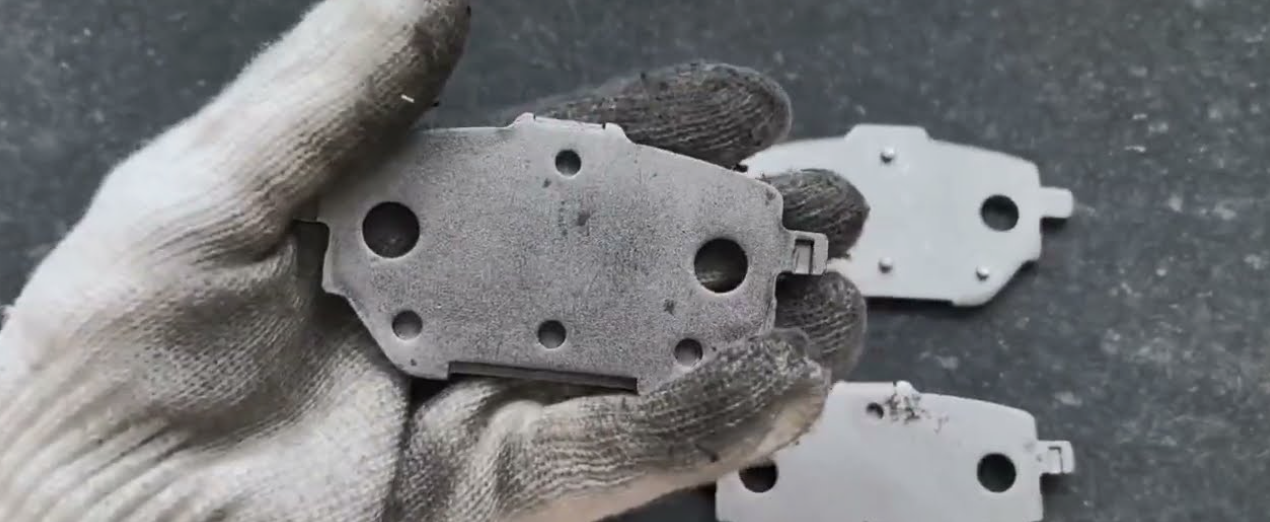
The steel backing plate is not merely a structural carrier—it is a precision component. OE quality pads use backing plates stamped and machined to tolerances of ±0.1 mm in thickness and profile. This precision ensures consistent caliper contact, even pad retraction, and correct ABS sensor clearance. Economy pads commonly use thinner-gauge steel (saving material cost) that can flex under high braking loads, introducing pedal pulsation and uneven pad wear.
Chamfers, Slots, and Surface Geometry
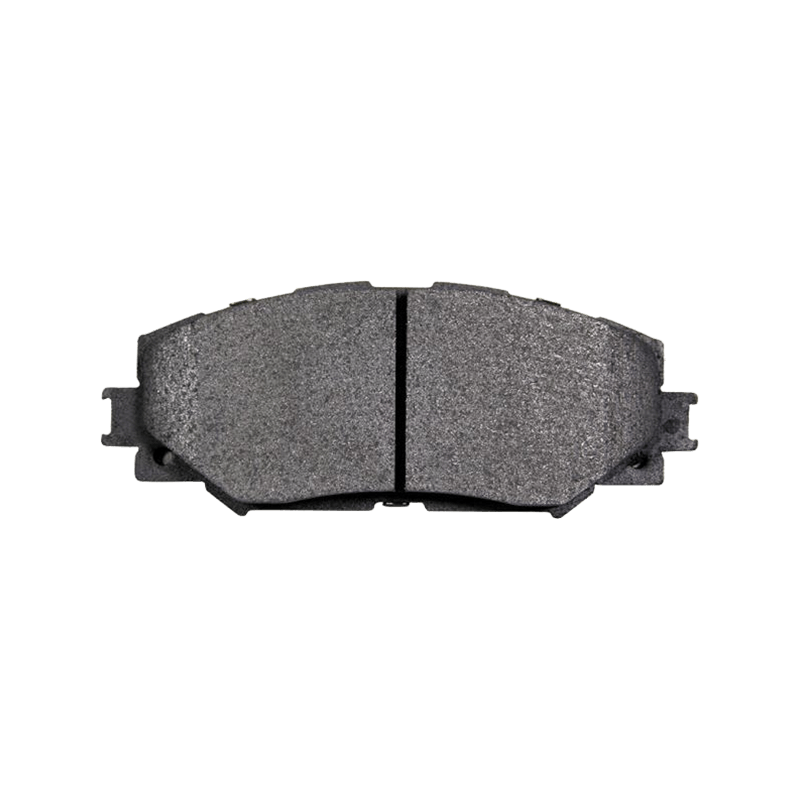
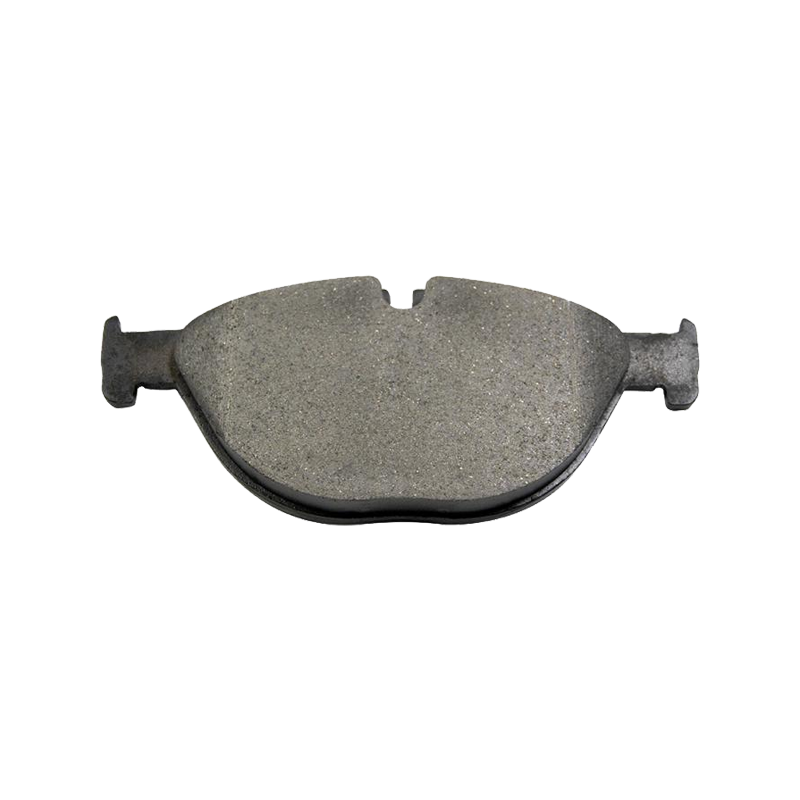
OE-specification pads include precisely located chamfers at the leading and trailing edges of the friction material, and in many cases machined slots through the pad body. These features are not aesthetic—they reduce the contact patch at initial pad engagement (reducing squeal frequency), provide a relief channel for gases generated during high-temperature braking, and prevent the pad from cracking under thermal stress. Many non-OE pads omit chamfers entirely or use simplified geometry that does not match the OEM specification, resulting in the characteristic high-frequency squeal common with economy pads.
Shims and Anti-Noise Layers
OE quality brake pads include multi-layer bonded shims on the backing plate. These shims serve as vibration dampers, decoupling the high-frequency oscillations generated at the friction interface from the caliper and knuckle—where they would otherwise be transmitted into the cabin as noise. OEM-grade shims typically consist of 2 to 4 layers of steel, rubber, and adhesive engineered to attenuate specific frequency ranges. Economy pads either use a single thin steel shim, a simple rubber coating, or no shim at all—making brake squeal under light braking conditions nearly unavoidable.
Rotor Compatibility and Long-Term System Cost
One of the most financially significant—yet least discussed—differences between OE quality and non-OE brake pads is the effect on rotor wear. Brake pads and rotors are a matched system; the OEM specifies a pad hardness and abrasive content that produces a controlled and predictable wear rate on the rotor's specific metallurgy.
Non-OE pads frequently use harder, more abrasive friction formulations than the OEM specification—either due to cost-cutting on binder materials or a deliberate choice to maximize perceived initial bite at the expense of rotor longevity. Field data from independent automotive research groups consistently shows that aggressive non-OE pads can reduce rotor service life by 30% to 50%. Since rotors typically cost $60 to $200 each, and most vehicles require two per axle, the apparent savings from a $15 economy pad set can easily be negated—and exceeded—by premature rotor replacement.
A realistic total cost comparison over 100,000 km of driving illustrates this clearly:
| Cost Item | OE Quality Pads | Non-OE Economy Pads |
|---|---|---|
| Pad replacements (front axle) | 2× replacements @ $70 avg = $140 | 4× replacements @ $22 avg = $88 |
| Rotor replacements (front axle, 2 rotors) | 1× replacement @ $160 = $160 | 2× replacements @ $160 = $320 |
| Labor (pad + rotor service @ $80/hr, 1.5 hrs) | 3× services × $120 = $360 | 6× services × $120 = $720 |
| Total 100,000 km brake cost (front axle) | $660 | $1,128 |
In this scenario, choosing non-OE economy pads costs $468 more over 100,000 km than OE quality pads—entirely negating the per-set price advantage and adding significant additional service appointments.
Quality Certifications That Identify Genuine OE Quality Brake Pads
When purchasing replacement brake pads, these certifications and standards reliably indicate OE-level quality. Absence of these marks on an unfamiliar brand is a significant warning sign:
- ECE Regulation 90 (R90): The most rigorous mandatory brake pad standard globally, required for all replacement pads sold in the EU and UK. R90 mandates that replacement pads achieve friction performance within ±15% of the OEM pad for the same vehicle application, verified by an independent approved testing body. R90-marked pads carry a standardized approval number that can be verified.
- FMSI/SAE Edge Codes: American friction material standards. The edge code stamped on an OE quality pad (e.g., "EE" or "FF") identifies the friction coefficient class at cold and hot temperatures as verified by SAE J661 dynamometer testing.
- IATF 16949: The automotive-specific quality management system standard. Manufacturers certified to IATF 16949 operate under documented quality controls, traceability requirements, and continuous improvement processes equivalent to Tier 1 automotive supplier expectations. This certification applies to the manufacturing facility, not individual products.
- ISO/TS 16949 lineage and OEM direct supply: Brands that supply pads directly to major automakers (Bosch, Brembo, Akebono, Continental, TRW/ZF) are validated to the highest possible standard. Their aftermarket lines use the same manufacturing infrastructure and quality systems.
When Non-OE Pads Are and Are Not Acceptable
Not all non-OE pads are equally problematic. The decision matrix below provides practical guidance on when to insist on OE quality and when a certified aftermarket alternative is acceptable:
- Always use OE quality or OEM pads: Vehicles with electronic brake force distribution (EBD), brake-by-wire, or integrated stability control systems that are calibrated to specific brake torque outputs. Also for high-performance vehicles, vehicles carrying heavy loads regularly, and any vehicle where the owner has safety-critical responsibilities (taxis, ambulances, school transport).
- Certified aftermarket OE-equivalent is acceptable: Standard passenger vehicles where ECE R90-certified pads from a reputable brand (Bosch, Brembo, Ferodo, Mintex, EBC) are chosen. These deliver equivalent OEM performance at 15–30% lower cost than dealer OEM pricing.
- Non-OE economy pads are not recommended: In any on-road application where consistent braking performance and passenger safety are required. The cost savings are real but are outweighed by the safety and total ownership cost implications documented throughout this article.
Frequently Asked Questions About OE Quality Brake Pads
Q1: Are OE quality brake pads the same as OEM brake pads?
Not exactly. OEM pads are the specific parts installed on the vehicle at the factory, carrying the automaker's part number and sold through dealerships at the highest price point. OE quality pads meet the same engineering specifications but are sold under the brake supplier's own brand (e.g., Bosch, Brembo, Akebono) through the aftermarket channel—typically at 20% to 40% lower cost than the dealer OEM part. In most cases, OE quality aftermarket pads are manufactured in the same facility, with the same tooling and materials as the OEM part; the only difference is the packaging and part number. For everyday driving, OE quality aftermarket pads represent the best balance of performance and value.
Q2: How can I tell if a brake pad is genuinely OE quality when shopping online?
Look for four indicators: (1) ECE R90 approval mark on the packaging and molded or stamped on the pad itself; (2) a recognized OEM-supplier brand such as Bosch, Brembo, Akebono, Ferodo, TRW, Continental, or Mintex; (3) FMSI edge codes stamped on the friction material; and (4) a vehicle-specific application listing that matches your exact make, model, year, and brake system. Avoid pads listed with vague multi-vehicle compatibility ranges, no certifications, and no brand transparency. A legitimate OE quality pad manufacturer will have a verifiable corporate identity and a published product application catalog.
Q3: Will using non-OE brake pads void my vehicle warranty?
In most markets, including the United States and European Union, using aftermarket parts does not automatically void a vehicle warranty under consumer protection laws (the Magnuson-Moss Warranty Act in the US, Block Exemption Regulations in the EU). However, if a non-OE brake pad causes damage to the brake caliper, rotor, or associated components, the manufacturer can decline warranty coverage for that specific damage by demonstrating that the aftermarket part caused the failure. Using ECE R90-certified OE quality aftermarket pads provides protection against this scenario—budget economy pads leave the owner fully exposed to consequential damage claims being denied.
Q4: Do OE quality brake pads require a bedding-in procedure?
Yes, but the process is minimal compared to non-OE pads. Most OE quality pads are factory-scorched, meaning the surface resin layer has been thermally cured during manufacturing, leaving a clean friction surface ready for near-immediate full performance. A standard bedding-in procedure of 10 moderate stops from 60 km/h to 10 km/h with 30-second cool-down intervals is sufficient to transfer an even friction layer to the rotor surface. Non-OE economy pads often require 20 to 30 more aggressive bedding cycles to reach stable friction performance, and some never fully stabilize—contributing to the inconsistent bite and occasional grabbing reported by users who install budget pads.
Q5: Can OE quality brake pads be mixed with non-OE pads on different axles?
This is technically possible but not recommended. Braking systems are engineered with a specific front-to-rear brake force distribution—typically 70:30 or 75:25 front-to-rear—that assumes matched friction coefficients at both axles. Installing high-friction OE quality pads at the front and low-friction economy pads at the rear (or vice versa) alters this balance. Under heavy braking, this can cause the rear wheels to lock prematurely (if rear friction is too high) or the front brakes to dominate excessively (if rear friction is too low), both of which compromise vehicle stability and stopping effectiveness. Always use the same quality level of pad on both ends of the same axle, and ideally the same specification front and rear.
Q6: Are there driving conditions where non-OE economy pads fail most noticeably?
Yes—the performance gap between OE quality and non-OE economy pads is most pronounced in three conditions: (1) repeated heavy braking from highway speeds (highway off-ramps, mountain descents), where thermal fade in economy pads becomes dangerous; (2) cold weather below 0°C, where economy pads with inconsistent binder formulations can exhibit significantly reduced initial bite for the first several stops; and (3) wet conditions, where economy pads with lower-quality surface treatment take longer to clear water from the rotor interface, increasing stopping distances by an additional 5% to 15% compared to OE quality pads in the same wet conditions. These are precisely the conditions where reliable brake performance matters most.

CONTACT INFOR.
-
 +86-152 5110 1941
-
 Info@yanitiger.com
-
 +86-152 5110 1941
-
 Building 5, Yancheng Financial City, No. 5 Century Avenue, Yancheng City, Jiangsu Province, China
Copyright © Yancheng Yanitiger Auto Parts Co., Limited All Rights Reserved. Custom Automobile Brake Products Factory OEM Automobile Brake Products Manufacturers
