
 English
 Português
 Español

Press the pedal in a 1,500 kg sedan travelling at 90 km/h and you are asking the brakes to remove roughly 470 kJ of energy in about four seconds. Your leg contributes 200 to 300 N. Closing that gap is the entire job of the braking system.
The short answer: car brakes stack two multipliers and then convert motion into heat. A pedal lever multiplies leg force by about 3:1 to 6:1, and the hydraulic ratio between master cylinder bore and caliper piston area multiplies it again, commonly by 4:1 to 8:1, before a booster adds its own share. The multiplied force clamps friction material against a rotating disc or drum, kinetic energy leaves as heat, and the tires turn the resulting torque into deceleration.
What follows follows that chain in order: the arithmetic at each step, the parts that carry it, the wear points that break it, and the fitment details that decide whether a replacement part restores the original pedal feel.
How Car Brakes Work: The Force Chain in Six Steps
One firm stop in a mid-size car runs through six links. The figures below are a worked example for a 1,500 kg sedan with a 4:1 pedal ratio and a 25.4 mm master cylinder, deliberately calculated without booster assistance so the arithmetic stays visible.
- Lever. The pedal pivots above your foot. Push 250 N into a pedal whose pushrod sits a quarter of the way up the arm and the rod sees about 1,000 N.
- Boost. A vacuum booster or electric actuator adds its own ratio, typically 2:1 to 6:1. Switch the engine off and pump the pedal: the reserve empties and the pedal goes hard.
- Pressure. Pressure equals force divided by piston area. A 25.4 mm bore exposes 507 mm2, so 1,000 N generates about 2.0 MPa, or 20 bar.
- Transmission. Brake fluid is close to incompressible, and by Pascal's principle the pressure is identical at every piston in the closed circuit. Only the areas differ, so only the forces differ.
- Clamp. Pressure times caliper piston area gives clamp force. Two 54 mm pistons present 4,580 mm2, so 20 bar becomes roughly 9 kN at each front wheel.
- Friction and torque. Pads with a friction coefficient near 0.40 turn that clamp force into about 7 kN of tangential force, and at an effective rotor radius of 120 mm that is roughly 870 Nm of brake torque per front wheel. Carry it through the tire radius and you land near 0.5 g before the booster is counted.
Notice what does not appear: nothing about the engine, the gearbox or the electronics. Hydraulic brakes are a self-contained mechanical system, which is why they still work when everything else stops working.
Component Map: Which Part Does What
The diagram shows the same chain as hardware. Force enters at the pedal, becomes pressure in the master cylinder, travels as pressure through rigid lines and flexible hoses, and becomes force again at the caliper or wheel cylinder.
| Component | Role in the chain | Symptom when it fails |
|---|---|---|
| Pedal and booster | Multiplies leg force, stores assist | Hard pedal, hiss under braking |
| Master cylinder | Turns rod force into line pressure | Pedal sinks slowly while held |
| Lines and hoses | Carry pressure to each corner | Bulging hose, pull to one side |
| ABS hydraulic unit | Modulates pressure per wheel | Warning lamp, no modulation |
| Caliper or wheel cylinder | Converts pressure back into force | Sticking piston, uneven pad wear |
| Pads, shoes, rotor, drum | Friction pair and heat sink | Squeal, judder, longer stops |
| Brake fluid | Transmits pressure, carries moisture | Spongy pedal after hard use |
Hydraulic Multiplication in Numbers
The most useful number when comparing brake parts is bore size, because pressure scales with the inverse of area. Halve the bore diameter and you quadruple the pressure for the same pedal force, but you also quadruple the fluid volume needed to move the piston a given distance, and pedal travel grows with it.
That trade-off explains why a larger master cylinder feels firmer and shorter but demands more leg effort, while a smaller bore feels softer and longer while generating pressure more easily. Manufacturers pick the bore to suit caliper piston volume, vehicle mass and booster capacity; changing one without the others is how a car ends up with a pedal that feels wrong even though every part is new.
Two readings follow. First, line pressure in ordinary driving sits between roughly 10 and 30 bar, which is why a small leak is felt long before it is seen. Second, because pressure is proportional to pedal force, a pedal needing noticeably more travel for the same stop is reporting a volume problem such as air, a bulging hose or a piston that is not retracting, not a friction problem. The relationships are worked through further in our guide to how master cylinders, fluid and calipers multiply force.
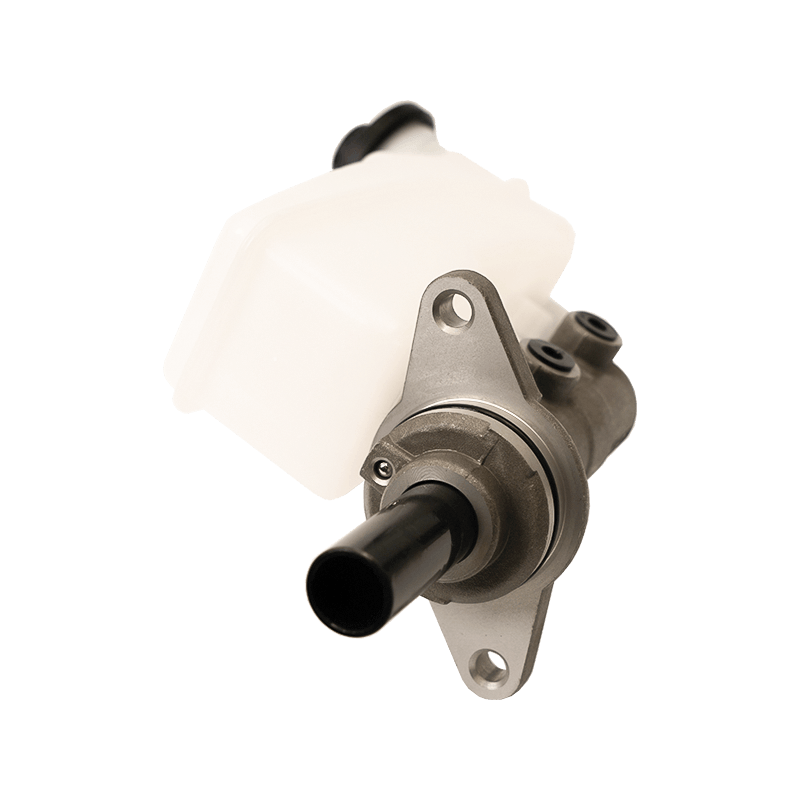 47201-0K010 Brake Master Cylinder for Toyota Hilux GGNOE-spec 13/16-inch aluminum master cylinder for Toyota Hilux GGN15/25/35, relevant when diagnosing hydraulic pressure and pedal-travel issues.View Product →
Friction: Where Motion Becomes Heat
Clamp force alone stops nothing. The last link is the friction pair, and it is the only link whose behaviour changes with temperature, water and time.
Friction coefficient, usually written as mu, is the ratio between tangential force at the pad surface and the clamp force pressing it down. A typical road pad runs between 0.35 and 0.45 when warm. What matters more than the peak figure is how flat that curve stays as temperature climbs, because a pad that loses a third of its friction at 500 °C has effectively lost a third of its braking force exactly when the driver is asking for the most.
Pad choice is therefore a curve-matching exercise rather than a quality ranking. Ceramic compounds hold a stable, quiet, low-dust curve at everyday temperatures; semi-metallic compounds trade some cold bite and extra dust for stability further up the range; high-carbon and performance pads push the ceiling higher still at the cost of rotor wear. Our brake pad range is grouped along exactly those lines, with ceramic and semi-metallic versions listed separately even where one OEM number covers both.
Disc vs Drum: Same Physics, Different Geometry
The hydraulics are identical; what changes is where the force lands and how the heat leaves.
| Aspect | Disc brake | Drum brake |
|---|---|---|
| Force application | Caliper clamps pads on both disc faces | Wheel cylinder pushes shoes outward |
| Self-energizing | None, output tracks pressure closely | Strong on the leading shoe |
| Heat path | Exposed to airflow on both faces | Enclosed casting, slower to shed heat |
| Fade behaviour | Gradual and predictable | Sharper once the drum expands |
| Service access | Pads and rotor exposed | Shoes, springs and adjuster inside |
A drum self-energizes because rotation drags the leading shoe into the drum, so the same line pressure produces more braking force. That efficiency is also why drums are harder to modulate and fade sooner: the heat has nowhere to go except into an enclosed casting that grows away from the shoes as it expands.
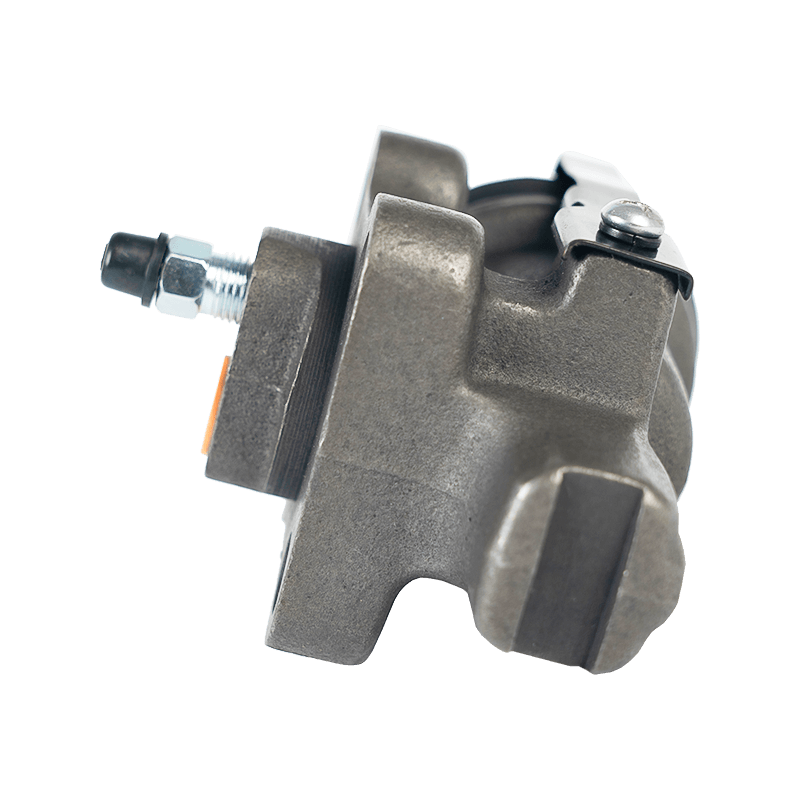 47510-36170 Brake Wheel Cylinder for Toyota Dyna 200OE-numbered 1 1/8-inch ferrous wheel cylinder for 1995–2003 Dyna 200 drum brakes, suited to routine hydraulic service and fitment checks.View Product →
What Wears Out, and What the Driver Feels
Wear is where the physics turns into a maintenance schedule, and the numbers are simple enough to check with a ruler.
- Pads. New linings measure about 10 to 12 mm; replace at roughly 3 mm. Front pads commonly last 30,000 to 60,000 km, rears longer on cars with electronic brake distribution.
- Rotors and drums. Every rotor carries a minimum thickness cast into the hub. Machine only within that limit; below it, heat capacity and judder resistance are gone.
- Fluid. Two years or 40,000 km is the usual interval because glycol fluid is hygroscopic. Test strips read moisture directly and cost far less than a caliper rebuild.
- Hoses. Look for bulging under pressure and cracking at the crimp. A hose that expands steals volume and shows up as a long pedal, not as a leak.
- Slide pins and pistons. A dragging caliper heats the fluid, glazes the pad and pulls the car. Uneven inner and outer pad wear is the tell.
Symptoms map to links, not to parts. A pedal that sinks slowly while held points at the master cylinder's internal seal. A pedal that is low but firm usually means rear adjustment or air in the circuit. Vibration through the wheel under braking points at rotor thickness variation, and a squeal only on light application is often glaze or a missing shim rather than a worn lining.
Matching Parts: Where Aftermarket Hydraulics Fail
For workshops and distributors, the failure mode that returns the most parts is not manufacturing quality but mismatch. Three checks catch most of it.
Match the bore, not just the bolt pattern
A caliper with the right mounting spacing but a different piston diameter changes the hydraulic ratio at that corner. Compare piston diameter, slide configuration and hose fitting before comparing price.
Match the OEM number and the build date
One model year frequently carries two master cylinder variants. The multi-number naming used in catalogue listings, where several OEM references are joined to a single part, exists precisely because those variants overlap. Verify every reference against the vehicle identification number rather than the model name alone.
Match the friction family to the duty cycle
A taxi fleet and a weekend car on the same platform do not need the same pad. Vehicles that stop two hundred times a day need heat stability; low-mileage cars benefit more from cold bite and low dust.
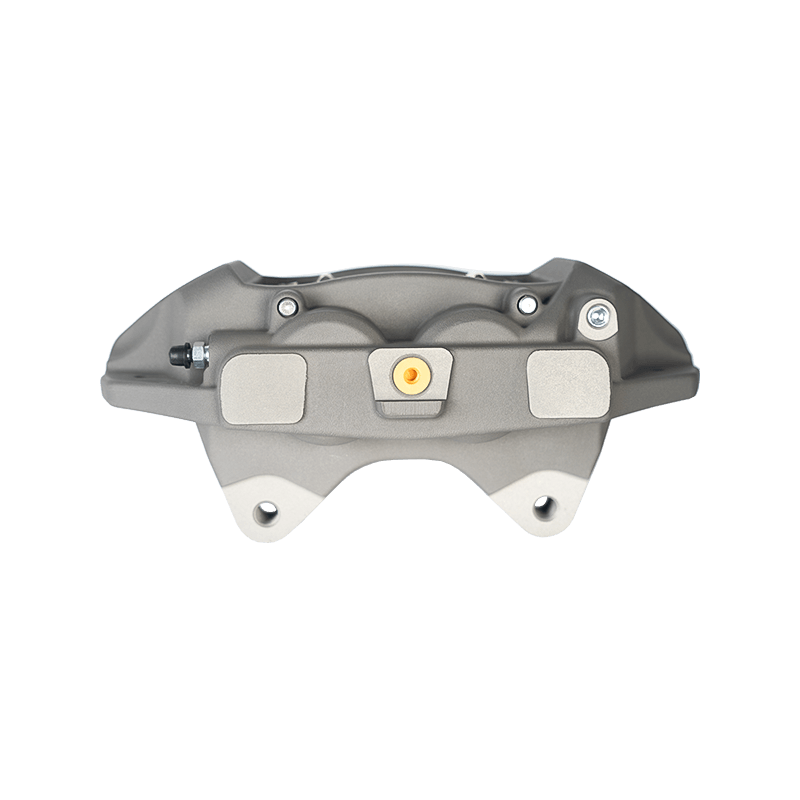 Automobile Brake Caliper – Contact for Model DetailsGeneral automobile brake caliper listing with model details available on request; verify fitment and specifications before ordering.View Product →
Yancheng Yanitiger Auto Parts Co., Limited has supplied brake and clutch hydraulics to aftermarket customers since 1998, with master cylinders, wheel cylinders, calipers and pads covering European, American, Russian, Japanese and Korean vehicles. Core lines are held to ISO 9001 and IATF 16949, with E-MARK R90 and AMECA certification, and cross-reference numbers are listed per part so the bore and fitting can be verified before ordering.
Frequently Asked Questions
Q1: How do car brakes turn pedal force into stopping power?
A: Through a lever and a hydraulic ratio. The pedal multiplies your leg force, the master cylinder converts it into line pressure, and each caliper piston multiplies it again by its own area before the pads convert it into friction and heat.
Q2: Why does my brake pedal feel spongy?
A: Air or moisture in the circuit is compressing instead of transmitting pressure. Bleed the system, check for a weeping wheel cylinder or caliper, and test the fluid for moisture before replacing hard parts.
Q3: How often should brake pads and brake fluid be replaced?
A: Pads at roughly 3 mm of lining, usually 30,000 to 60,000 km on the front axle, and fluid every two years or 40,000 km because glycol fluid absorbs moisture and loses boiling point.
Q4: Do bigger brake calipers shorten stopping distance?
A: Rarely on their own. Larger pistons raise clamp force at a given pressure but also increase fluid demand; if the master cylinder and booster cannot supply that volume, pedal travel grows and the gain disappears. Tires usually set the real limit.
Q5: What causes brake judder, squeal or a pulling car?
A: Judder points to rotor thickness variation or uneven pad transfer, squeal to glaze or bedding, and pulling to a dragging caliper or a collapsed hose on one side.
Q6: Are ceramic brake pads better than semi-metallic?
A: It depends on duty. Ceramic pads are quieter and cleaner with a stable curve at normal temperatures, while semi-metallic pads hold friction better as temperatures climb. Match the compound to how the vehicle is actually driven.