
 English
 Português
 Español

A caliper that fits the bracket but carries the wrong piston bore will bolt up, bleed clean, and still hand the driver a long, vague pedal. It is one of the most common reasons a brake job comes back to the shop, and it never shows up on the invoice. The buying rule is narrow: match the original piston diameter, bracket offset, handedness and hose connection, then confirm the housing has been pressure tested and the seals are EPDM. Coating colour and box branding do not change clamping force.
What an Automotive Brake Caliper Does in the Hydraulic Chain
The caliper is the last mechanical link in a chain that runs from the pedal to the rotor: booster, master cylinder, ABS modulator, hose, caliper, pads, disc. Brake fluid is essentially incompressible, so pressure built in the master cylinder arrives at the caliper almost undiminished. A single 54 mm piston exposes roughly 2,290 mm² of area; at 20 bar it pushes about 4.6 kN into the pad backing plate, and because a floating housing reacts against the outboard pad, the disc sees close to double that as clamping force. None of this is adjustable at the parts counter, which is why bore matching matters more than brand preference. If you want the component-level walkthrough, our explainer on how an automotive brake caliper works covers piston, seal and slide-pin geometry in detail.
Floating or Fixed: Match the Architecture Before the Part Number
Most passenger cars leave the factory with a floating caliper: one or two pistons on the inboard side, a bracket that lets the housing slide on lubricated pins, and an outboard pad driven by reaction force. Fixed calipers use opposed pistons and cost more, but they hold stiffness through repeated heat cycles, which is why performance and heavier vehicles use them. Getting the architecture wrong is not cosmetic. A floating caliper fitted where a fixed one belongs will not sit square on the disc, and a fixed caliper on a sliding bracket will drag from the first stop.
| Characteristic | Floating (sliding) caliper | Fixed caliper |
|---|---|---|
| Piston layout | One or two pistons, inboard side only | Opposed pistons on both sides of the disc |
| Housing movement | Slides on guide pins and bushings | Bolted rigidly to the knuckle |
| Main wear points | Slide pins, bushings, seal groove | Piston seals, dust boots, bridge stiffness |
| Typical fitment | Passenger cars, SUVs, light commercial | Performance, heavy-duty, larger SUVs |
| Service note | Pin lubrication and boot condition decide drag | Even retraction on both piston banks |
| Cost position | Lower; highest aftermarket volume | Higher; fewer cross-references |
The service difference is practical: on a floating design, a dry slide pin mimics a failed piston almost perfectly, so a caliper is sometimes replaced when a boot and a sachet of grease would have solved it.
Inside the Caliper: Where Failure Usually Starts
Four areas decide whether a caliper lasts: the piston bore, the square-cut seal, the dust boot and the slide-pin bore. The square-cut seal does double duty — it holds pressure and retracts the piston by a few hundredths of a millimetre when pressure releases. Once that groove corrodes, retraction is lost, the pad grazes the disc and heat builds.
Goods-in inspection should target those same four points, because a caliper that fails a bore gauge or a boot pull will fail on the vehicle within weeks, not months.
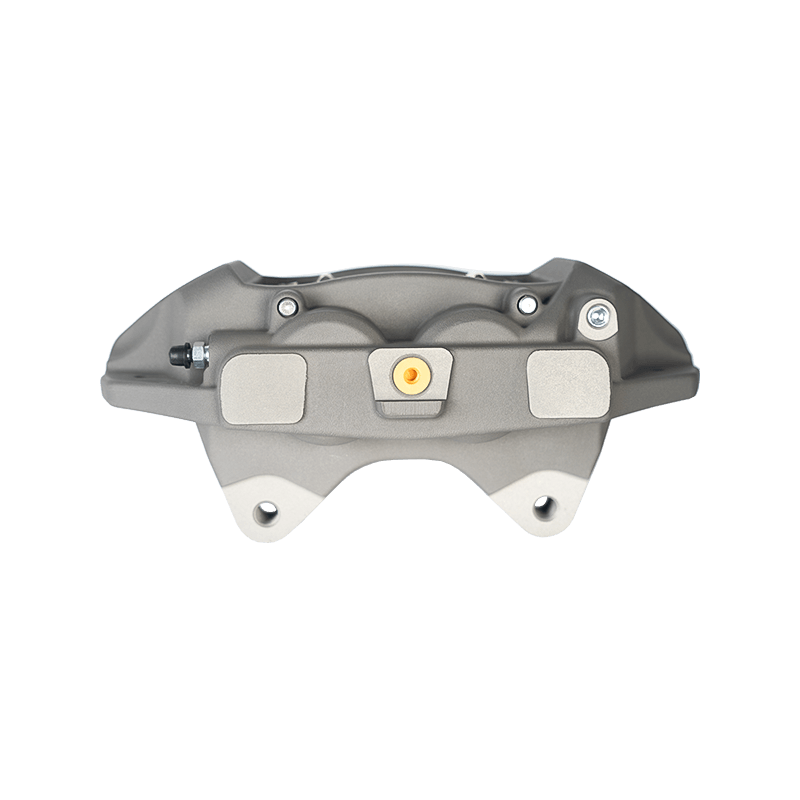 Automobile Brake Caliper for Hydraulic Braking SystemsProduct entry for a general automobile brake caliper; check contact route first, since bore, piston and application details must be confirmed before inspection.View Product →
Bore Size and Piston Count Decide Pedal Feel
Two numbers travel together: master cylinder bore and caliper piston area. Pushrod force is fixed by pedal ratio and booster, so a smaller master cylinder bore raises line pressure and shortens pedal effort, at the cost of longer travel and greater fluid displacement. The chart below holds pushrod force at a constant 1,000 N to show how the same pedal effort converts into different line pressure on three common master cylinder bores.
At the caliper end the logic reverses. Larger pistons multiply line pressure into more clamping force but need more fluid to move, so the pedal travels further. A floating caliper's effective area is twice its piston area because the housing reacts on the opposite pad, which is why a 54 mm sliding piston and a pair of 38 mm fixed pistons can land in a similar place. Fitting a caliper with a different bore without changing the master cylinder shifts front-to-rear balance, and that usually shows up first as early ABS intervention or rear lock-up on light vehicles.
Failure Signals That Send a Caliper Back to the Supplier
Diagnosis is quick once you know where to look. These five patterns account for most caliper replacements in aftermarket workshops.
- Uneven pad wear across an axle: one pad at 2 mm while its partner sits at 8 mm points to a sticking piston or a dry slide pin, not to pad quality.
- Fluid at the hose union or behind the dust boot: a wet boot is a leaking piston seal, and it will contaminate the pads on that corner.
- Pull to one side under braking that disappears when the caliper releases, usually a seized slide pin or a collapsed flexible hose acting as a one-way valve.
- Metallic grinding with a hot wheel: the pad is metal-to-metal and the disc is already below minimum thickness.
- Parking brake or EPB faults on rear calipers, where a screw-and-piston mechanism strips its internal thread if the piston is forced back without service mode.
Hub temperature after a short drive is the fastest confirmation. A corner running 20 to 30 °C hotter than its opposite is dragging, and no amount of pad compound will fix it.
What Distributors Should Verify Before Ordering
Returns in this category are rarely caused by manufacturing defects. They are caused by a cross-reference that ignores side, bore or actuator type. The checklist below is the one we would apply to any caliper, whoever builds it.
| Check | What to verify | Risk if skipped |
|---|---|---|
| OEM cross-reference | Number, model year range and axle position | Part bolts on but pads sit off-centre |
| Handedness | Left or right casting and piston position | Bleed screw ends up low, air stays trapped |
| Piston diameter | Measured, not assumed from the photo | Pedal feel and brake balance shift |
| Slide pins and boots | Free movement, correct grease, no splits | Drag, heat, premature pad wear |
| Pressure test | Housing held at test pressure with no drop | Weeping seal found by the customer instead |
| Coating | Zinc or EDP on the whole body, including the groove | Corrosion inside the seal bore within two winters |
| Threads | Bleed screw and banjo threads clean and true | Cross-threading during bleeding |
Cross-referencing is where a supplier earns its keep. One casting often serves several OEM numbers across model years, and the catalogue has to show that overlap clearly enough for a counter clerk to confirm it in under a minute.
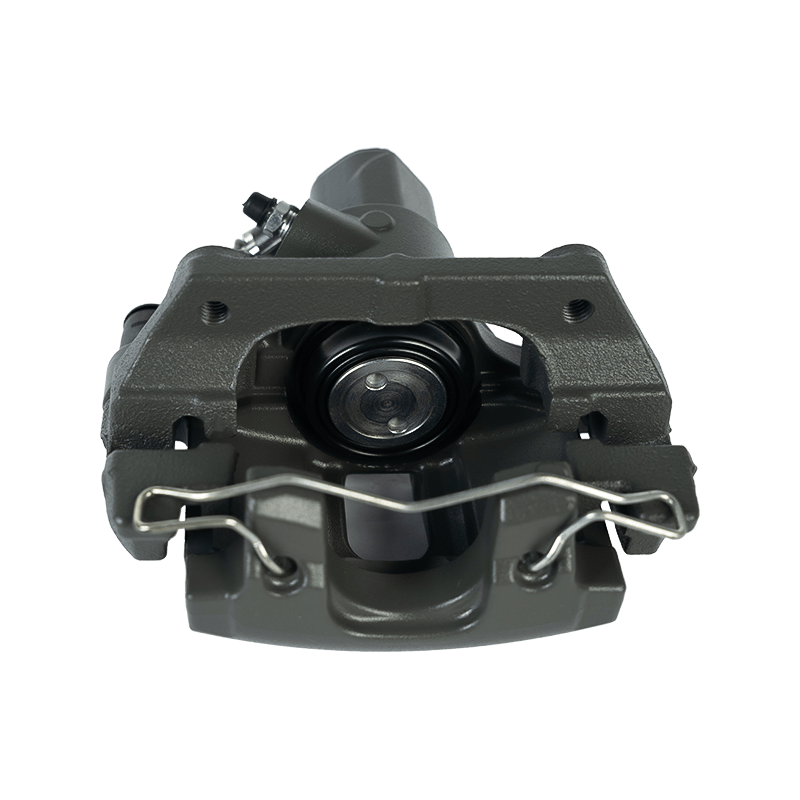 8M5Z2552B Brake Caliper for Ford CMax and EscapeOE-numbered 38 mm aluminum caliper for Ford CMax 2013–2017 and Escape 2013–2016; useful for cross-reference checks, with pressure-tested assembly and IATF 16949 controls.View Product →
How a Caliper Range Is Built for Global Aftermarket Buyers
Yancheng Yanitiger Auto Parts Co., Limited has supplied brake and clutch hydraulics since 1998, and the caliper range reflects what aftermarket buyers actually order: coverage across European, American, Russian, Japanese and Korean vehicles rather than a single-platform catalogue. Published figures are 7,000-plus hydraulic part numbers and more than 1,000 brake shoe and pad references, shipped to over 30 countries.
Documentation matters as much as the parts list. The company works to ISO 9001 and IATF 16949, and core products carry E-MARK R90 and AMECA certification, which is the paperwork a distributor needs when a workshop asks whether a replacement caliper meets the same regulatory baseline as the original.
Alongside standard replacement units, the catalogue covers calipers for modified vehicles, where piston area and bracket geometry change together and cannot be mixed with standard components.
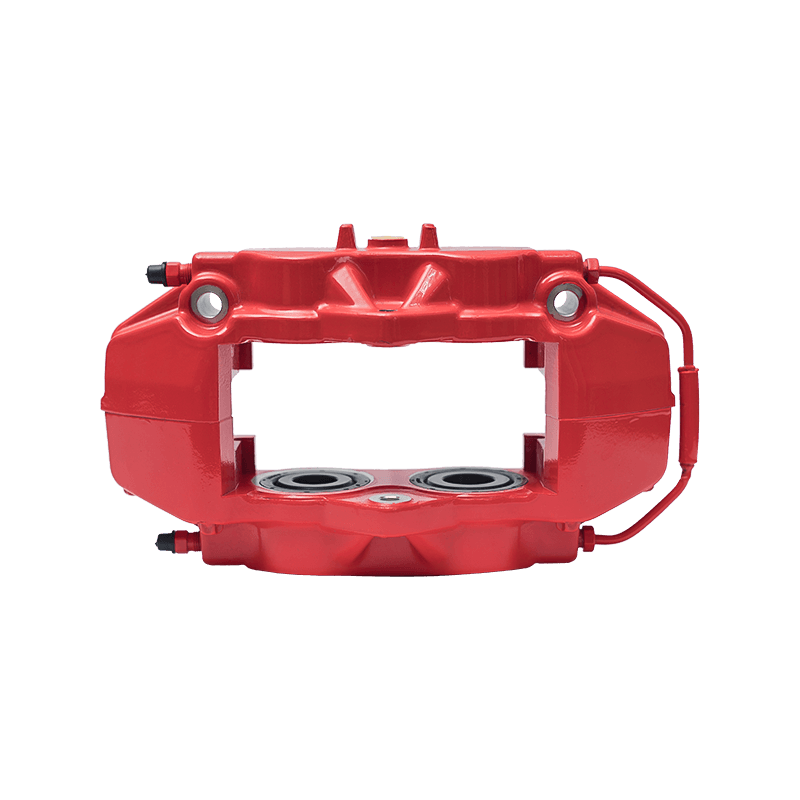 BB0401-3501100 Brake Caliper for Modified VehiclesAluminum caliper with 41.3 mm and 38.1 mm diameters for modified vehicles; confirm OE number, axle and side before matching piston area and bracket geometry.View Product →
Installation Details That Cause Comebacks
Fitting is where a good caliper is most often ruined, and the fix costs nothing but discipline.
- Never let the caliper hang from the flexible hose. The internal reinforcement collapses and turns the hose into a one-way valve that drags the brake.
- Open the bleed screw before retracting a piston, and use service mode on electric parking brakes.
- Torque bracket bolts and the banjo bolt to the manufacturer's figure with a calibrated wrench. Copper sealing washers are single-use items.
- Bed the pads in with a series of moderate-to-firm stops, and replace fluid older than three years, because DOT 4 absorbs moisture and boils earlier than the specification suggests.
A caliper is only as good as the friction pair under it, so match calipers with brake pads from the same supplier and the same friction family, otherwise the balance you calculated at the bore stage is lost at the pad surface.
Frequently Asked Questions
What are the signs of a bad brake caliper?
Uneven pad wear, a wheel that runs noticeably hot, fluid behind the dust boot, a pull to one side, or a pedal that stays low after release. Two or three of these together usually mean replacement rather than cleaning.
Can you drive with a seized brake caliper?
Only to the nearest workshop, at low speed. A dragging caliper builds heat quickly, and a disc can drop below minimum thickness within a few kilometres. Treat it as a recovery job, not a commute.
How long do brake calipers last?
Typically 100,000 to 150,000 km where roads are not heavily salted. Severe winters and infrequent fluid changes shorten that considerably, because moisture attacks the seal groove from the inside out.
Do I need to replace brake calipers in pairs?
Replace both sides on vehicles over about eight years old, or whenever one side shows corrosion. Matching wear and hydraulic response across an axle keeps brake balance predictable.
What is the difference between a brake caliper and a wheel cylinder?
A caliper clamps pads onto a disc; a wheel cylinder pushes brake shoes outward inside a drum. Both convert hydraulic pressure into friction, but seals, bleed points and service procedures differ.
Are remanufactured calipers as good as new ones?
It depends on the bore. A remanufactured unit is only as good as the re-plating inside the seal groove, so ask for a pressure test record and confirm the piston, seal and boot are new rather than reused.